
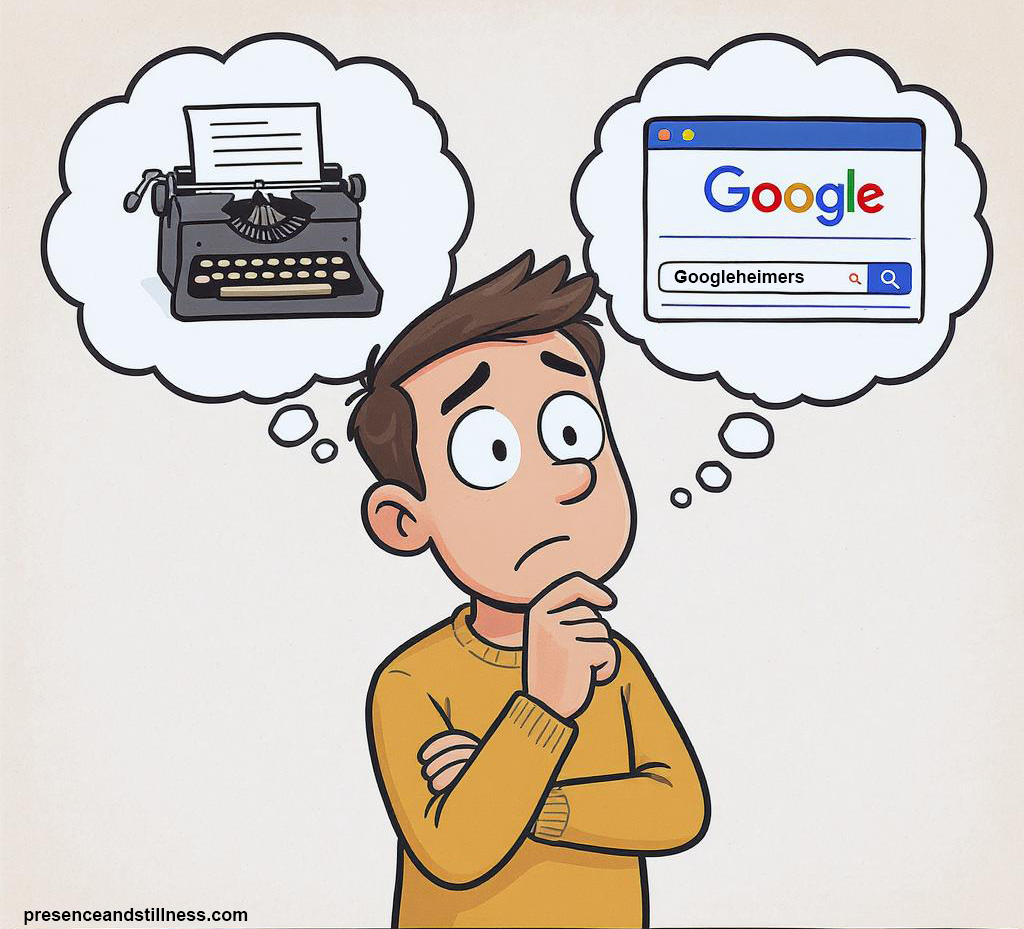
In a world where nearly any fact is just a few keystrokes away, it’s no surprise that our relationship with memory has changed. We no longer have to carry as much information in our minds—we just need to remember where to find it. I like to call this effect “Googleheimer’s” (though conventionally it has been called the “Google Effect”.)
What Is Googleheimer’s?
Googleheimer’s, is my term for what is also known as “The Google Effect” or “digital amnesia”, first identified by researchers Betsy Sparrow, Jenny Liu, and Daniel Wegner in 2011. Googleheimer’s refers to our tendency to forget information that we know we can easily look up later. Instead of storing the details themselves, our brains store the location or method for retrieving them. In other words, we’ve essentially outsourced part of our memory to the internet.
Why Does This Happen?
Humans have always used tools to extend our cognitive abilities—writing, libraries, calendars, maps. The internet is simply a more powerful version of the same concept.
But Googleheimer’s takes this one step further. With information accessible in seconds, our minds prioritize efficiency:
Why memorize facts when we can look them up instantly?
Why store specifics when a search engine can recall them faster and more accurately?
Why hold onto information that may quickly change or become outdated?
This isn’t laziness—it’s a clever use of limited mental resources. The brain is wired to automate, optimize, and focus on what matters most.
Googleheimer’s: A New Kind of Intelligence. Googleheimer’s doesn’t mean we’re becoming less intelligent—it means the nature of intelligence is evolving. The modern mind isn’t designed to be a warehouse; it’s designed to be a network. And networks thrive on connections, not stockpiles. As long as we remain active participants—questioning, learning, thinking intentionally—having a search engine as a mental sidekick can be an enormous strength and is, in essence, an evolutionary development in human thinking (or forgetting, depending on how you look at it.)
#transactive memory #cognitive load #internet dependence #memory recall #attention span #digital amnesia #googleheimers